Chabuki
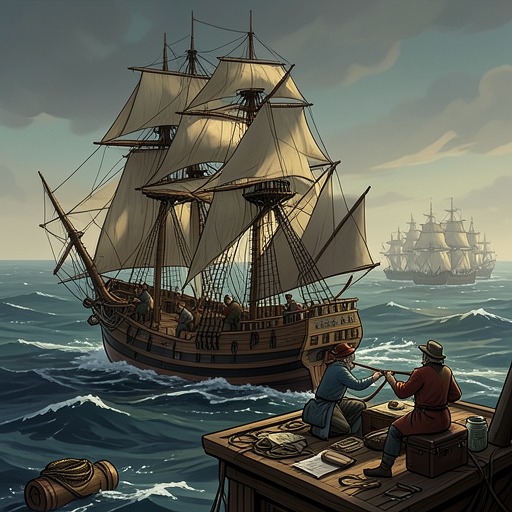
The Romance of the Three KingdomsRed Cliffs is the setting of the Battle of Red Cliffs, where the southern forces’ fire attack destroyed Cao Cao’s chained fleet and reversed his expectation of an easy victory. The place matters not merely as a backdrop: the river, the wind, and the confined movement of the ships make the battlefield itself part of the stratagem.
Setting and Strategic Stakes
The battle takes place at Red Cliffs amid the southern campaign against Cao Cao. The southern commanders face a much larger opposing force, and the account presents the outcome as dependent on finding a way to use fire against Cao Cao’s navy. A southeasterly wind is crucial to the plan: without it, the fire cannot be driven toward the chained ships.
Deception and the Wind
The approach to Red Cliffs is prepared through deception. Huang Gai advances in battle armour under a banner identifying him as the vanguard, appearing to be carrying out the promised defection. Cao Cao initially reads the sight as confirmation that the southern forces are yielding. Cheng Yu recognizes the danger: the vessels are riding too high in the water to be laden with grain, and their speed under the wind gives away the attack. By then, however, the ships are already approaching.
The wind that makes the assault possible has been prepared for in a striking scene on Nanping Mountain. At Zhou Yu’s request, Kong Ming arranges for an altar to be built and claims he can summon a southeasterly wind lasting three days and nights. The altar is nine feet high, has three levels, and is surrounded by 120 banner carriers. This episode links the battle’s practical requirement to the novel’s portrayal of Kong Ming’s command of unusual arts; at Red Cliffs, the wind becomes the condition that gives the fire attack its force.
The Fire Attack
At Huang Gai’s signal, twenty fireboats crash into Cao Cao’s chained ships. Because the vessels cannot escape one another, flames spread from ship to ship, while catapulted missiles from the southern shore add to the assault. The account depicts the junction of the rivers as engulfed in a widespread battle in which fire and attacks by soldiers compound the fleet’s destruction.
Cao Cao escapes with Zhang Liao’s help as the fighting throws his army into confusion. Huang Gai pursues him by skiff but is struck by an arrow and falls into the river; Han Dang later recognizes and rescues him, and he recovers. The battle therefore brings danger to both sides’ commanders even as its overall course turns against Cao Cao. The closing poetic summary focuses on the destruction of the ships at Red Cliffs, making the fleet’s ruin the defining image of the encounter.
Consequences and Narrative Significance
Red Cliffs marks the collapse of Cao Cao’s expected victory and the success of the southern forces’ coordinated deception and fire attack. The scene’s dramatic reversal rests on the contrast between Cao Cao’s confidence that Huang Gai is defecting and Cheng Yu’s belated recognition that the apparently light vessels are an immediate threat. The river and wind convert that misreading into a battle-changing advantage.
The novel also places this encounter within a wider story of Han collapse and competing leaders carving kingdoms from the empire’s ruins. Its account combines historical events with later dramatic retellings, and Red Cliffs becomes a concentrated example of that method: a struggle for political and military power rendered through a conspicuous setting, a reversals-driven stratagem, and a memorable poetic image of ships destroyed by fire.